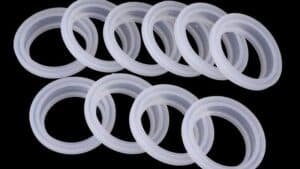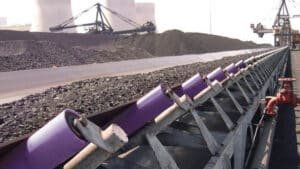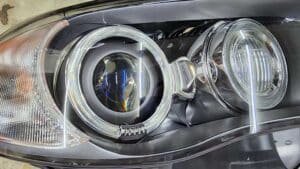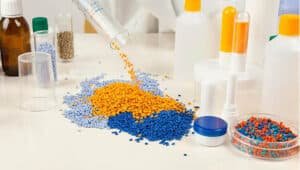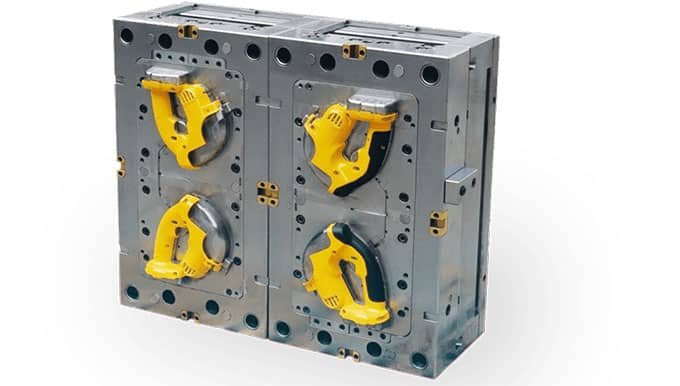
Thermoplastic elastomers (TPEs) are a family of polymers that combine the flexibility and softness of rubber with the processing efficiency of thermoplastics. Unlike thermoset rubbers, TPE materials can be melted and reprocessed, offering recyclability and design versatility. TPE injection molding and overmolding uses these properties to create soft layers on rigid parts, improving grip and comfort.
What Is TPE Overmolding?
TPE overmolding service is a two-stage molding process. The process typically begins with the formation of a rigid base component through standard injection molding. Once this substrate cools and solidifies, it is placed into a second mold cavity, where molten TPE is injected over the surface areas where bonding is desired.
As the TPE cools, it adheres to the underlying substrate through either molecular bonding, mechanical interlocking, or a combination of both. The result is a composite product that merges the structural strength of the base material with the tactile and functional benefits of TPE.
TPE Overmolding vs. 2K Overmolding
While TPE overmolding and 2K overmolding (also known as two-shot molding) share similar goals, their manufacturing processes differ significantly. The comparison below summarizes the key distinctions:
Substrates Compatible with TPE
TPE can bond to various engineering plastics when their solubility parameters are compatible. Common substrates include PP, PE, PA6/PA66, PC, ABS, PC-ABS blends, ASA, and SAN. For materials like PBT or PMMA, surface treatments such as plasma activation can enhance adhesion between TPE and the substrate.
Why TPE Bonds to Plastic Substrates?
The strength of TPE bonding to rigid plastics depends on several key factors, including surface energy, flow behavior, and material compatibility.
For strong adhesion, the TPE and substrate should have similar surface energies, this allows the molten TPE to spread evenly and form close molecular contact with the plastic surface.
Flow properties also matter: overmolding-grade TPEs with moderate viscosity and good flowability can better fill fine surface details and enhance bonding.
Finally, chemical compatibility determines whether molecular chains can interlock or diffuse at the interface. When the materials are incompatible, the bond relies mainly on mechanical interlocking rather than true molecular adhesion.
Advantages of TPE Overmolding
Improved Functionality: Adds non-slip surfaces and vibration damping; electric toothbrush handles reduce user fatigue.
Cost Reduction: Eliminates adhesives and assembly; part costs drop in high volumes with single-mold use.
Design Options: Allows variable thickness (1–3 mm) and hardness gradients for ergonomic shapes in tools or device cases.
Enhanced Durability: Increases scratch and chemical resistance; extends product life with peel-resistant bonds.
Sustainability: Fully recyclable, no volatiles, compliant with REACH standards.
Important Considerations in TPE Overmolding
To achieve strong bonding and consistent part quality, several factors must be carefully controlled during the TPE overmold process:
- Too low a TPE molding temperature can lead to poor encapsulation (especially edge delamination or lifting at the seam), while too high a temperature can cause substrate deformation.
- The substrate surface must be clean and free of mold release agents or oil. Any surface residue will directly damage the bond.
- Avoid sharp corner transitions; use rounded corners or stepped designs to enhance mechanical interlocking.
- The initial injection speed should not be too fast to prevent TPE from overflowing through gaps.
- The mold must be designed with good venting channels (0.01–0.03 mm), especially in the area where the TPE is last filled.
- TPE is prone to deformation or stretching; sufficient cooling time is essential.
- For transparent TPE encapsulated parts, any impurities or air bubbles will be very noticeable.
Applications of TPE Overmolding
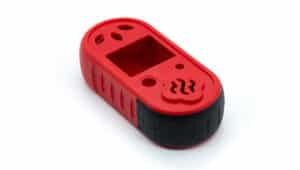
TPE overmolding is widely used across industries where comfort, grip, and functional integration are essential:
Automotive: Door handles, steering grips, pedal covers, and interior trim components.
Consumer Electronics: Device housings, protective cases, and ergonomic buttons.
Industrial Tools: Soft-grip power tool handles and vibration-damping components.
Medical Devices: Catheter grips, syringes, and other components requiring soft-touch surfaces.
Household Products: Toothbrush handles, kitchen utensils, and personal care accessories.
Difference Between TPE and TPU Overmolding
Although both thermoplastic elastomer (TPE) and thermoplastic polyurethane (TPU) are used in overmolding applications, they serve slightly different purposes.
- TPE Overmolding is ideal for soft-touch and ergonomic parts, offering easy processing and cost-effectiveness. It provides sufficient flexibility and adhesion for general applications.
- TPU Overmolding, on the other hand, provides higher hardness, abrasion resistance, and chemical durability. It is often chosen for parts that must endure harsh mechanical or environmental conditions.
Conclusion
TPE overmolding is one of the most versatile and efficient manufacturing techniques. From automotive interiors to consumer electronics, TPE molded parts are widely used due to the soft-touch, ergonomic and durable.
Our professional team will tailor the ideal bonding and overmolding solutions to meet your specific needs.